
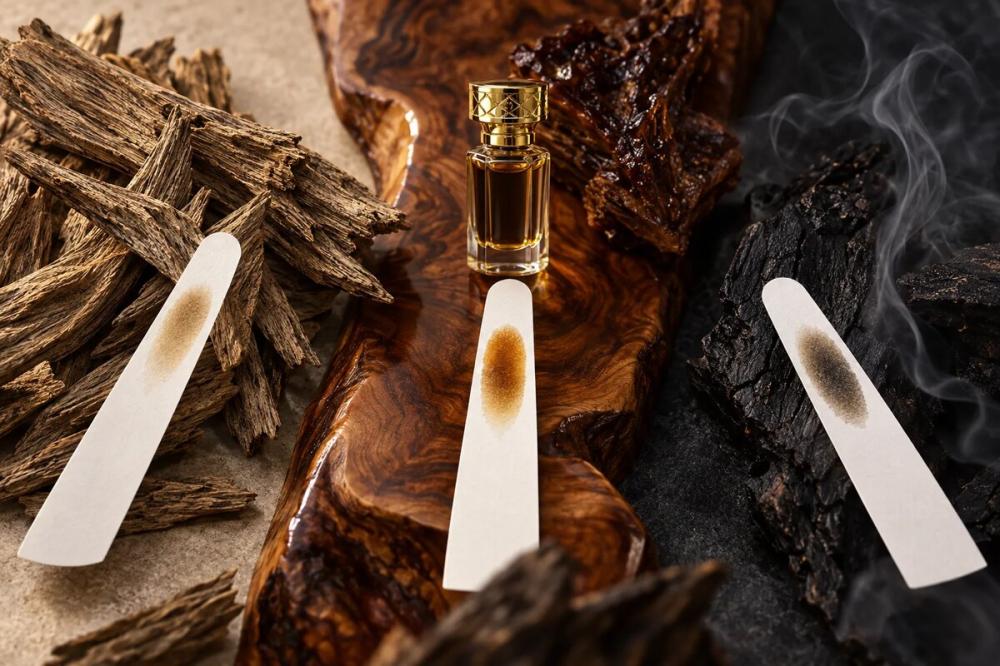
Looking for one best type can obscure an appealing feature of oud oil: variation. Similar names can conceal different openings, developments and dry-downs because of raw material, distillation, maturation and batch differences. A sensory map is more useful than an absolute ranking of countries. It helps you describe a sample and compare it under consistent conditions.
Dry and woody
This profile may suggest wood fibres, dry air or gentle spice. It can appeal to someone who dislikes obvious sweetness, but it is not automatically a higher grade.
Warm and sweet
The impression may evoke resin, a hint of honey or polished wood. Perceived sweetness is not proof of a sweet ingredient being added; smell alone cannot establish formula.
Smoky and leathery
These impressions can relate to the material, production process or development in wear. Begin with a tiny amount and assess whether the character remains comfortable at your usual distance.
Animalic or fermented impressions
Animalic is a sensory description, not proof of an animal ingredient. Some oils have a sharp or fermented opening that later softens, so the first minute is not the whole experience.
Keep a simple sampling record
Record the product or sample code, batch reference if available, application time, amount and testing surface. Revisit the scent after the opening settles and again later. Use a few clear words at each stage; the timing is a personal comparison aid, not a fixed development schedule for every oil.
Turn the map into a purchase decision
Ask for a sample from the current batch, a definition of the trade name, volume, use directions and storage details. Choose the progression you enjoy returning to, not the most luxurious-sounding description.
Why the batch belongs in your notes
A second purchase under the same name may seem different from your memory. Check the batch, opening date and storage conditions before reaching a verdict, and compare with a suitably stored reference if one is available. Memory alone cannot establish identical formula. Ask whether the bottle comes from the earlier batch or a new supply and what material or processing details are available. Difference does not automatically mean improvement or decline, but it should be described clearly so a returning customer knows what to expect.
Build a collection that broadens your preferences
If you already enjoy a sweet oud oil, a drier or more woody direction may teach you more than another name serving the same role. Ask what the new bottle adds: a quieter daytime option, a different evening character, or a scent you want to explore alongside a particular musk. You do not have to seek variety for its own sake. The point is to avoid accumulating similar purchases without a clear purpose. A successful addition earns a real place in your routine.
Confirm the product type
Establish whether the bottle is described as a distilled oud oil or a blend, then check the size and intended use. If a particular origin or purity claim affects your decision, ask for details tied to the product. For background, read how oud oil is made.
Write a description you can revisit
Begin with words another person can understand: dry or sweet, light or dense, close or noticeable. Then add an association such as warm wood, a floral impression or a clean feeling. These are sensory comparisons, not ingredient declarations. A scent that reminds you of honey does not necessarily contain honey. Record dislikes precisely too: was the opening sharp, or did the settled scent feel heavy? The word bad offers little help for a future purchase. Revisit your description on another day without forcing the same conclusion, since context affects perception. Repeated words will gradually reveal your preferences and make product descriptions easier to interpret. The aim is a useful personal vocabulary, not complicated terminology.
Compare descriptions from the current collection
Read the individual descriptions of Old Indian Kalakasi Oud Oil and Cambodian Kalakasi Oud Oil within OUDNNA’s oud oil collection. Use their stated scent characters as a starting point for sampling, and ask about the current batch when reordering a favourite.
Common questions
Does origin alone determine the scent?
No. Raw material, distillation, age, storage and the particular batch also matter.
Choose the development you enjoy
A useful oud choice is one you can describe, trace and enjoy as it develops. A sensory map offers more guidance than a rigid league table.
For a practical next step, follow our guide to sampling oud oil, or explore how to read an Indian Kalakasi description.
Further reading
These references provide background information and do not certify the composition, origin or quality of an individual store product.