
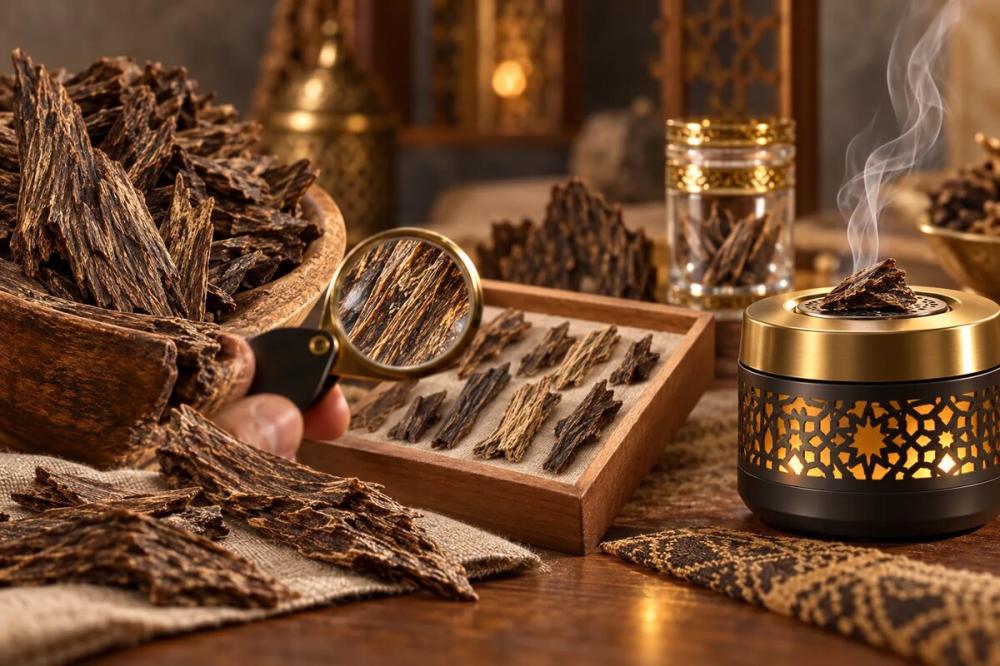
The agarwood story begins before the burner, in resin-bearing wood associated with certain Aquilaria and Gyrinops trees. What reaches the buyer also reflects harvesting, cleaning, drying, sorting, storage and commercial naming. Understanding those stages helps you read a product description with a better sense of what each detail means.
Variation within the wood
Resin is not distributed evenly, so a piece can contain lighter and darker areas. Such variation is not automatically a defect, nor is it proof of authenticity by itself.
From preparation to drying
Removal of lighter wood, moisture level, drying and storage can change weight and heating behaviour. Ask whether the offered batch is dry and whether any treatment has been applied.
Sorting is supplier specific
Grade names vary between suppliers and markets. Super becomes useful only when the seller explains the criteria and shows the actual batch being sold.
Understanding the source
Ask what the geographical or trade name means for the offered batch, and what sourcing records are available. Some stages may be documented while others are not. A useful description makes those limits clear instead of filling them with a story.
At the burner
Begin with a small piece and gentle heat in a suitable adjustable electric incense burner, following its instructions. Observe the scent before charring dominates. Excessive heat can make different samples seem alike because burnt notes overwhelm their distinctions. Keep the burner clear of combustible materials and respect anyone sensitive to smoke. Never burn charcoal indoors; the CPSC explains the carbon monoxide danger.
Build your own record
Record the batch name, sample weight, heat setting and a few sensory terms. Those notes are more useful for future purchases than repeating an unsupported market ranking.
What to check when the wood arrives
Compare the received wood with the ordered weight, photographs and description. Keep the product name, receipt date and any batch reference together. If something differs materially from what you ordered, ask the seller before using the full package.
Source information and a scent trial answer different questions. Records can explain where a batch came from; a controlled trial helps you decide whether you enjoy it. Neither replaces the other.
Give each package a simple record
Packages become easy to confuse after a few weeks. Label each with the product name, receipt date and any available batch reference, and keep a photograph of the contents when opened. Choose a stable place away from direct sun, heat and strong surrounding odours, following the supplier's directions. Do not moisten wood to revive its scent or add perfume and then compare it with an untreated sample: that changes the subject of the trial. If an unusual change appears, separate the package and contact the seller before heating it. Avoid reviewing several open packages in a strongly fragranced room. A name, photograph, storage location and short observation are enough. They also make repeat purchases more precise than simply asking for a familiar trade name.
Use product details to guide your next question
OUDNNA’s Natural Malino Oud Wood and Natural Kalimantan Oud Wood offer two descriptions to explore in the natural oud wood collection. Check the current weights and piece sizes, then ask about preparation or batch details that matter to you.
Common questions
Does every agarwood-producing tree yield the same fragrant material?
No. Resin formation and distribution vary; a species name does not guarantee a uniform fragrant product.
From a product story to practical knowledge
Understanding the material and its recorded journey makes the final heating trial more informative. Use gentle heat to reveal the wood, not a story to decide the result in advance.
To build on this guide, read Oud Wood Shapes and Their Effect on Heating and Incense Prices and the Cost of a Session.
For background on resin formation, see the research review of agarwood formation and induction. General research explains the material; it does not certify an individual commercial batch.
Further reading
These references provide background information and do not certify the composition, origin or quality of an individual store product.